
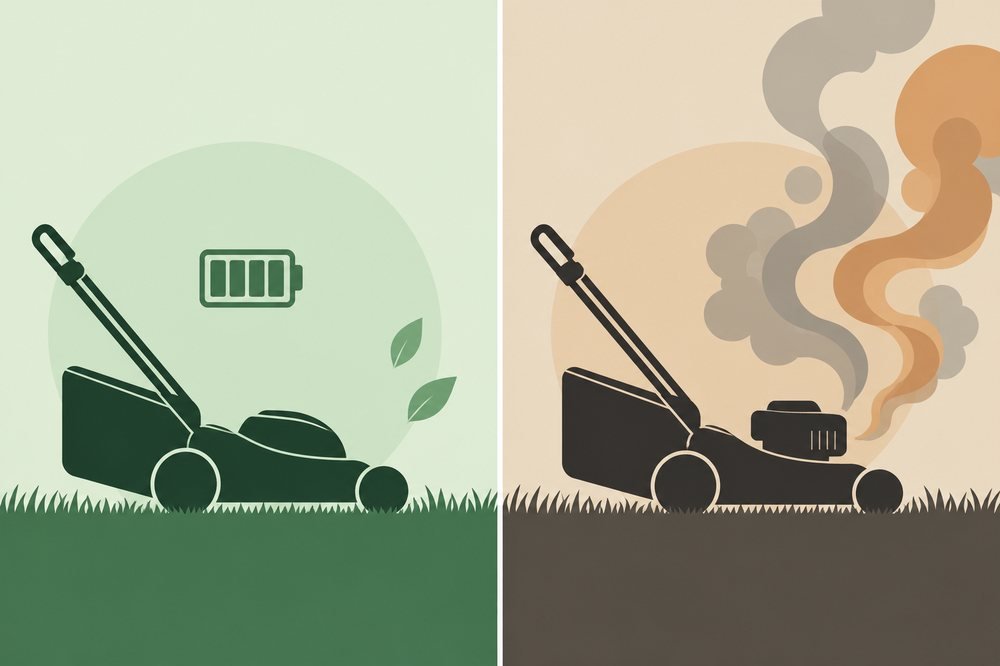
Four myths about battery lawn equipment
Three of these are out of date. One of them is still true, and we would rather say so.
We hear the same four objections, in roughly the same order, on almost every first visit. Here they are with straight answers.
“The batteries die halfway through”
This was a real problem, and it was a real problem quite recently. It stopped being one when crews started carrying enough packs rather than waiting for bigger ones. A swap takes seconds and the machine goes back to full output immediately.
The honest version of this objection is not about the equipment, it is about the company. A crew that turns up with two packs will have a problem. A crew equipped for full-day routes will not.
“It won't handle an overgrown lawn”
This one is partly true and we are not going to pretend otherwise. A neglected first cut, in wet growth, on a large property, is the job where sustained torque matters most and where gas still has an edge.
We handle those with a different approach and a different quote rather than promising something the equipment does not do easily. On maintained turf, which is the great majority of the work, the difference disappears.
The place to be suspicious of any contractor is where they claim there are no trade-offs at all.
“Electric must cost more”
Higher purchase price, lower running cost. No fuel, no two-stroke mix, no oil changes and dramatically less small-engine maintenance, which is the hidden cost that eats gas-based operations. Across a season it comes out close to even, which is why our pricing sits in line with conventional crews in the same neighbourhoods.
“Isn't this just marketing?”
Fair question, and there is a simple test. Ask any contractor to send you their equipment list, machine by machine. Most cannot or will not. Ours is published on the site, with typical noise figures next to each item.
A brochure line about being green costs nothing to write. A published spec sheet is checkable.