Moona's Gardens
Full transparency

Every machine we run, on the record.

Almost no landscaping company publishes what its crews actually carry. We do — because the equipment is the reason our service is different, and you shouldn't have to take “eco-friendly” on faith.

The fleet

Not one machine we own runs on gasoline.

EquipmentTypical noiseDirect emissionsWhat it changes on site
Battery blower~65 dBNoneRoughly conversational. Usable next to open windows and patios without generating complaints.
Battery mower~75 dBNoneAbout the level of a vacuum cleaner rather than a chainsaw.
Battery string trimmer~72 dBNoneNo two-stroke whine, and no fuel mix to spill on beds or turf.
Battery hedge trimmer~70 dBNoneSteady torque for clean cuts, with no exhaust blowing back into foliage.
Battery packsSilentNoneEnough charged packs in the pick-up to run continuous full-day routes without a mid-shift stop.

Noise figures are typical published values for commercial battery equipment measured near the operator. Readings vary by model, load and distance — at 15 metres, every number above drops sharply.

Interactive

What a season on gas would have cost the air.

Move the slider to the number of visits your property gets in a season.

0 miles

Equivalent driving distance in a 2017 Toyota Camry, if the same visits were done with gas equipment.

Assumes 20 minutes of blower use and 30 minutes of mower use per visit. Per-hour equivalents come from the California Air Resources Board's Small Off-Road Engines fact sheet, which reports that one hour on California's best-selling commercial leaf blower emits smog-forming pollution comparable to driving a 2017 Toyota Camry about 1,100 miles, and one hour on the best-selling commercial mower about 300 miles. This is an illustration of scale, not a measurement of any specific machine or property.

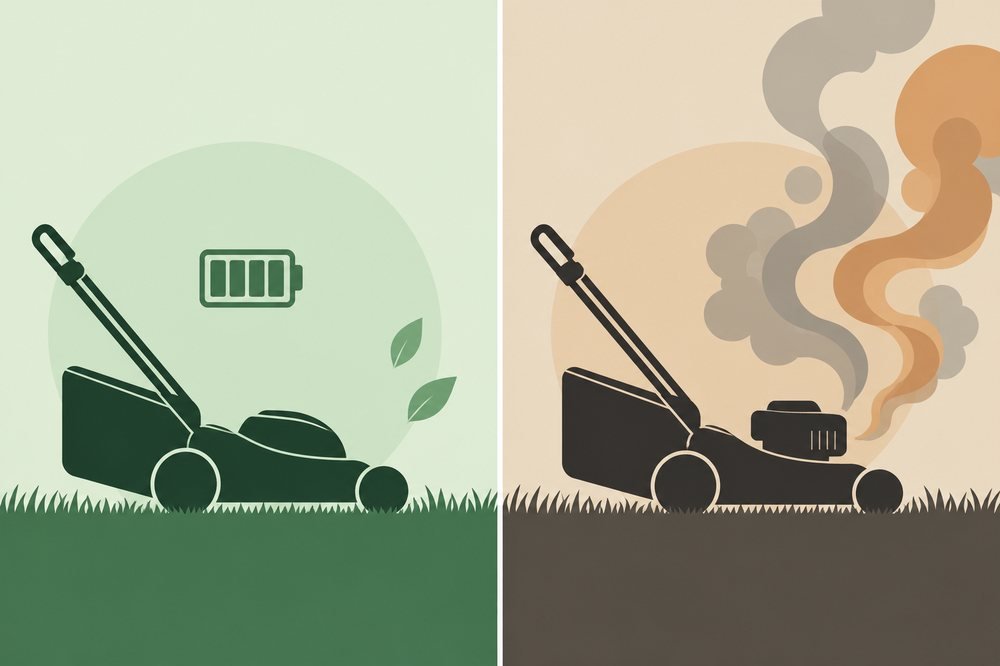
Illustration comparing a battery mower with a gas mower emitting exhaust
Straight answers

The objections we hear most.

“Batteries die halfway through.”

They did, five years ago. We carry enough charged packs to run continuous routes for a full working day, and swapping one takes seconds. Nobody on our crew has ever had to stop for a charge mid-property.

Solved by pack count

“It won't handle an overgrown lawn.”

A neglected first cut on a large property is the one job where gas still has an edge. We handle those with a different approach and a different quote rather than pretending the difference isn't there.

Planned differently

“Electric must cost more.”

Our pricing sits in line with conventional crews in the same neighbourhoods. We spend more on equipment and less on fuel and small-engine repair, and it comes out roughly even.

Market rate

“Is this just marketing?”

Ask any contractor to send you their equipment list. The page you're reading is ours. If the answer you get is a brochure line about being green, that's the difference.

Published, not claimed
Illustration of a city skyline seen across a green park
Regulation

Where the rules are heading.

Nothing is banned in Ontario today, and we won't pretend otherwise. But the direction is not ambiguous.

In May 2025, Toronto City Council decided against banning gas-powered small-engine equipment. Instead it voted to convert the city's own lawn and garden fleet to electric and to run a public education campaign, with staff reporting back on progress in 2027.

Mississauga has been on a similar path since its Green Tools pilot introduced battery equipment to city operations in 2021. Elsewhere the shift is further along: California banned the sale of new gas-powered lawn equipment, and a growing list of North American municipalities have phased out gas leaf blowers outright.

None of that obliges you to change contractors. It does mean a property already running on electric equipment is not going to be caught out later.

Want the full equipment list for a proposal?

Ask us for it