
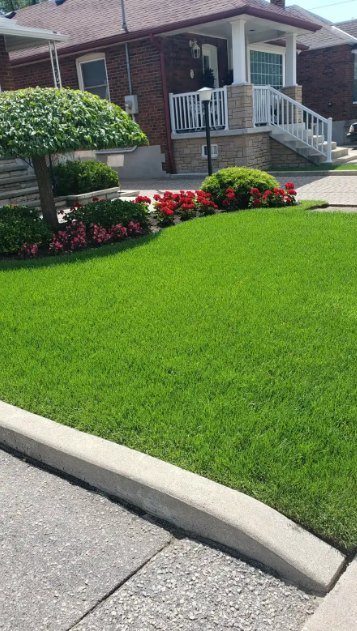
The first cut of the season
It is the most commonly rushed job in lawn care, and the one that sets up everything that follows.
After an Ontario winter the instinct is to cut the lawn short and get it looking tidy. That instinct is exactly wrong, and it costs the lawn several weeks of recovery it did not need to spend.
What the lawn has just been through
Five months under snow, then a freeze-thaw cycle, then saturated clay soil. The root system has been dormant and the plant is running on stored energy. It is at its weakest point of the entire year.
Cutting hard now removes the leaf area the plant needs to photosynthesise its way back, and it does that at the precise moment the plant has the least reserve to recover with.
Scalping a lawn in April buys a tidy week and costs a month.
Set it high
Cut at the top of the normal range for the first pass, around 8 to 9 centimetres. It will not look as sharp as a short cut, and it will green up faster and thicker within two weeks.
Bring the height down gradually over the next two or three cuts if you want it shorter, never in a single pass.
When the lawn is actually ready
- The soil is firm enough to walk on without leaving prints
- Growth has visibly resumed, not just greened up
- There is no standing water anywhere on the property
- The forecast has no hard frost in the next week
On clay soil in Mississauga this is usually mid-to-late April, later than most people expect. Mowing a saturated clay lawn compacts it under the mower wheels in a pattern you will still see in July.
What to do before the first cut
Clear the debris. Anything left on the lawn goes through the mower, and matted leaf and twig gets shredded into the turf rather than removed. A proper spring cleanup happens before the first cut, not after it.
Sharpen the blade
First cut of the season on last season's blade is how a lawn ends up grey a day after mowing. The extra growth from an unmowed winter is exactly the kind of load that shows a dull edge.