
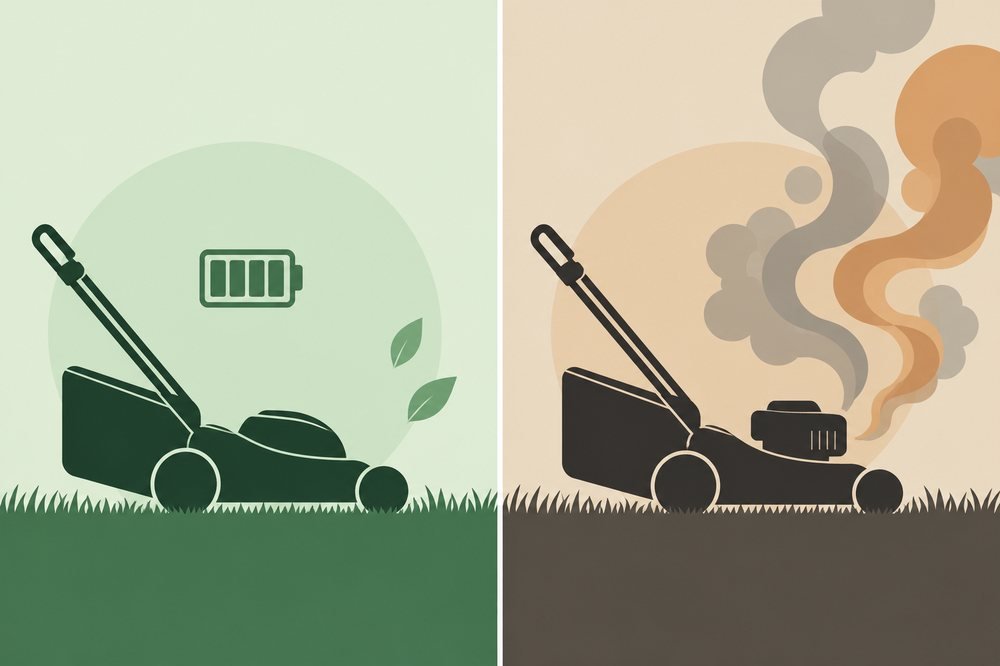
Gas versus electric: what actually changes for your lawn
We run battery equipment, so treat this as an interested party being straight with you rather than a neutral review.
The debate is usually argued badly on both sides. Gas users say battery equipment is underpowered, which stopped being broadly true a few years ago. Battery advocates imply gas has no advantages left, which is not true either.
Cut quality: no difference on a maintained lawn
On turf that is cut regularly at a sensible height, the finish is identical. Same stripe, same clean edge, same result. Anyone who tells you they can spot the difference on a weekly-maintained lawn is guessing.
Where gas genuinely still wins
Sustained load on badly overgrown turf. A first cut on a property that has not been touched in six weeks, in wet growth, on a large lot, is the one job where a gas machine's ability to hold torque indefinitely matters. We plan those jobs differently rather than pretending otherwise.
The second is very large acreage, where the sheer running time makes battery logistics awkward. Neither applies to a typical Mississauga residential property.
The honest gap is one job type, not a general performance difference.
Run time, and why it stopped being the problem
A single pack does not last a working day. That was the real objection five years ago, and the answer was never bigger batteries, it was more of them. A crew carrying enough charged packs swaps in seconds and never stops. The constraint moved from the machine to how the company equips itself.
Noise, which is the difference you actually notice
- A gas backpack blower runs near 100 decibels at the operator
- A battery blower sits around 65, roughly conversational volume
- Decibels are logarithmic, so that gap is far larger than the numbers look
- A gas mower is around 95, a battery mower closer to 75
Emissions
Small off-road engines are dirty per hour of operation in a way that surprises people. The California Air Resources Board reports that one hour on the best-selling commercial gas leaf blower produces smog-forming pollution comparable to driving a 2017 Toyota Camry about 1,100 miles, and one hour on the best-selling commercial mower about 300 miles.
Those are California figures for specific machines and we quote them for scale, not as a measurement of any particular crew. The order of magnitude is the point.
Cost
Roughly a wash. Battery equipment costs more to buy and less to run, with no fuel, no oil, no mix and far less small-engine repair. Our pricing sits in line with conventional crews in the same neighbourhoods.